This post is the twenty-second in a series in which we reached out to municipal candidates to ask their heritage platform. Responses will be posted in the order received.
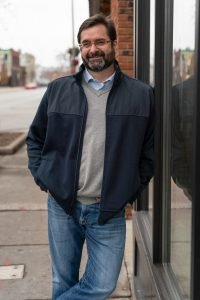
Ken Acton was the twenty-second candidate to respond. He is running for the Ward 5 seat in the City of Windsor – the catchment area of which East Windsor between Pillette and Lauzon and includes the neighbourhood of Riverside.
Our urban history has the ability to evoke emotion, drive culture and shape our identity. When we commit to preserving the historic fabric of our built environment, we create opportunities to generate value and build the places that people love!
The Bandshell located in Jackson Park, is one such place. The current structure was built in 1959 to replace the original built in 1950, which fell victim to a fire in 1957. It was designed by Windsor Architects Johnson & McWhinnie, who also designed the Cleary Auditorium & Convention Hall (1958–60), and the former main branch of the Windsor Public Library at 850 Ouellette Avenue. Both notable buildings in their own right, by a firm woven into Windsor’s architectural history.
As the Bandshell’s history is tied to Emancipation Day and Walter Perry, it not only provides us with a tangible link to the past but a true reflection of the evolution of our society. The Emancipation Day events that were held there in the 1950’s and 60’s were some of the largest celebrations in Canada, and attracted individuals from all walks of life.
The City of Windsor and Council have the ability to recognize that fact, and foster a movement that creates value, while resisting the idea of disposable communities that form meaningless environments, lacking a distinct character, community, or purpose. Funding a feasibility study to assess the possible restoration and future use of the Bandshell would be a progressive and appropriate step in that direction. The City and Council should also be working to increase advocacy and support for historic places. Buildings such as Sandwich First Baptist Church and Our Lady of the Assumption Church are not just local neighbourhood landmarks, they are pillars of our Canadian history.
Recent changes to the Ontario Heritage Act under Bill 23 have created an environment that favours the demolition of non-designated properties on municipal heritage registries. These changes are forcing municipalities to either formally designate buildings, in a compressed timeline, or drop them from their registry. The deadline for municipalities to issue a notice of intention to designate for listed buildings is January 1, 2027. If a municipality fails to issue a notice by the respective deadline, the building must be removed from the registry and cannot be re-listed for a five-year period.
This haphazard approach to historic preservation and development, ignores both our culture and the significance of the built environment. Approached properly, historic preservation projects have the ability to encourage investment, honour our past and create unique communities, that increase value and bolster civic pride.
Windsor’s losses have been great, but a few notable projects include St. Mary’s Academy, the Norwich Block, Carnegie Library, and Riverview Hospital which was originally built as Ford City Public School. However, the Norwich Block’s original Dominion Bank façade (1908–1909) that was dismantled in 2000 and is currently in storage, provides an opportunity for us to reclaim a piece of that past.
As an advocate for labour history, Ford City’s lost buildings and altered streetscapes pose a specific concern. The Ford Powerhouse, which is one of my favourite buildings, was designed by Albert Kahn and built in 1922. The building is currently at risk of being removed from the City of Windsor Municipal Heritage Register next January. If this occurs, the Powerhouse could become vulnerable to redevelopment scenarios, including demolition. Stripping the designation would leave the building completely unprotected against future redevelopment. Although Ford Canada recognizes this iconic structure and its contribution to Canadian history as being part of the largest single wartime workplace in our nation, I believe that formally preserving the property would be the best course of action. Its aesthetic and history continue to define a culture that still resonates within our community today.
As an Executive within the Windsor Region Society of Architects and the immediate past Chair of the 2026 Architectural Conservancy of Ontario’s Heritage Awards, my appreciation of our historic structures runs deep. I truly believe that by preserving our past we have the opportunity to create a more meaningful future, and if elected to serve on Windsor’s City Council, I would work diligently to highlight our historically significant places.
To follow the candidate’s campaign, visit his website.
Featured picture courtesy of Ken Acton
 English (Canada)
 English (United States)